missing translation for 'onlineSavingsMsg'
Learn More

Invitrogen™ PD-1 (CD279) Recombinant Rabbit Monoclonal Antibody (RM309)

Artikelnummer. 15947164
Change view
Click to view available options
Menge:
100 μL
Packungsgröße:
100 Mikroliter
1 product options available for selection
Product selection table with 1 available options. Use arrow keys to navigate and Enter or Space to select.
Artikelnummer. Menge unitSize
15947164 100 μL 100 Mikroliter
Use arrow keys to navigate between rows. Press Enter or Space to select a product option. 1 options available.
1 options
Dieser Artikel kann nicht zurückgegeben werden. Rückgaberichtlinie anzeigen
Artikelnummer. 15947164 Lieferant Invitrogen™ Lieferanten-Nr. MA527899

Bitte Sie sich an, um diesen Artikel zu kaufen. Sie benötigen ein Web-Konto? Registrieren Sie sich noch heute!

Dieser Artikel kann nicht zurückgegeben werden. Rückgaberichtlinie anzeigen

Rabbit Recombinant Monoclonal Antibody

Recombinant rabbit monoclonal antibodies are produced using in vitro expression systems. The expression systems are developed by cloning in the specific antibody DNA sequences from immunoreactive rabbits. Then, individual clones are screened to select the best candidates for production. The advantages of using recombinant rabbit monoclonal antibodies include: better specificity and sensitivity, lot-to-lot consistency, animal origin-free formulations, and broader immunoreactivity to diverse targets due to larger rabbit immune repertoire.

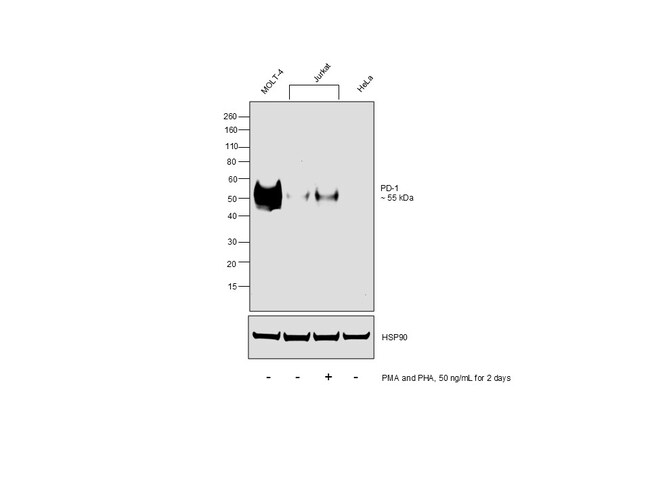
Cell-mediated immune responses are initiated by T lymphocytes that are themselves stimulated by cognate peptides bound to MHC molecules on antig en-presenting cells (APC). T-cell activation is generally self-limited as activated T cells express receptors such as PD-1 (also known as PDCD-1) that mediate inhibitory signals from the APC. PD-1 can bind two different but related ligands, PDL-1 and PDL-2. Upon binding to either of these ligands, signals generated by PD-1 inhibit the activation of the immune response in the absence of 'danger signals' such as LPS or other molecules associated with bacteria or other pathogens. Evidence for this is seen in PD1-null mice who exhibit hyperactivated immune systems and autoimmune diseases. Despite its predicted molecular weight, PD-1 often migrates at higher molecular weight in SDS-PAGE.
TRUSTED_SUSTAINABILITY

Spezifikation

Antigen PD-1 (CD279)
Anwendungen Flow Cytometry, Immunohistochemistry (Paraffin), Western Blot
Klassifikation Recombinant Monoclonal
Klon RM309
Konzentration 0.5 mg/mL
Konjugat Unconjugated
Zusammensetzung PBS with 0.09% sodium azide; pH 7.4
Gen Pdcd1
Gen-Zugriffsnummer Q15116
Gen-Alias CD279; EGK_05005; hPD1; hPD-1; hPD-l; hSLE1; Ly101; mPD-1; PD1; PD-1; Pdc1; Pdcd1; programmed cell death 1; programmed cell death 1 protein; programmed cell death protein 1; programmed cell death protein 1-like; programmed death 1; Protein PD1; protein PD-1; sCD279; SLEB2; soluble CD279; systemic lupus erythematosus susceptibility 2
Gensymbole Pdcd1
Wirtsspezies Rabbit
Immunogen A peptide corresponding to the N-terminus of human PD-1.
Reinigungsverfahren Affinity chromatography
Menge 100 μL
Regulatorischer Status RUO
Primär oder sekundär Primary
Gen-ID (Entrez) 5133
Zielspezies Human
Inhalt und Lagerung Store at 4°C short term. For long term storage, store at -20°C, avoiding freeze/thaw cycles.
Produkttyp Antibody
Form Liquid
Isotype IgG
Mehr anzeigen Weniger anzeigen
Name des Produkts
Wählen Sie ein Thema

Indem Sie auf Absenden klicken, erklären Sie sich damit einverstanden, dass Fisher Scientific sich mit Ihnen in Verbindung setzen kann, um Ihr Feedback in diesem Formular zu bearbeiten. Wir werden Ihre Informationen nicht für andere Zwecke weitergeben. Alle bereitgestellten Kontaktinformationen werden in Übereinstimmung mit unserer Datenschutzrichtlinie aufbewahrt. Datenschutzrichtlinie.