missing translation for 'onlineSavingsMsg'
Learn More
Learn More

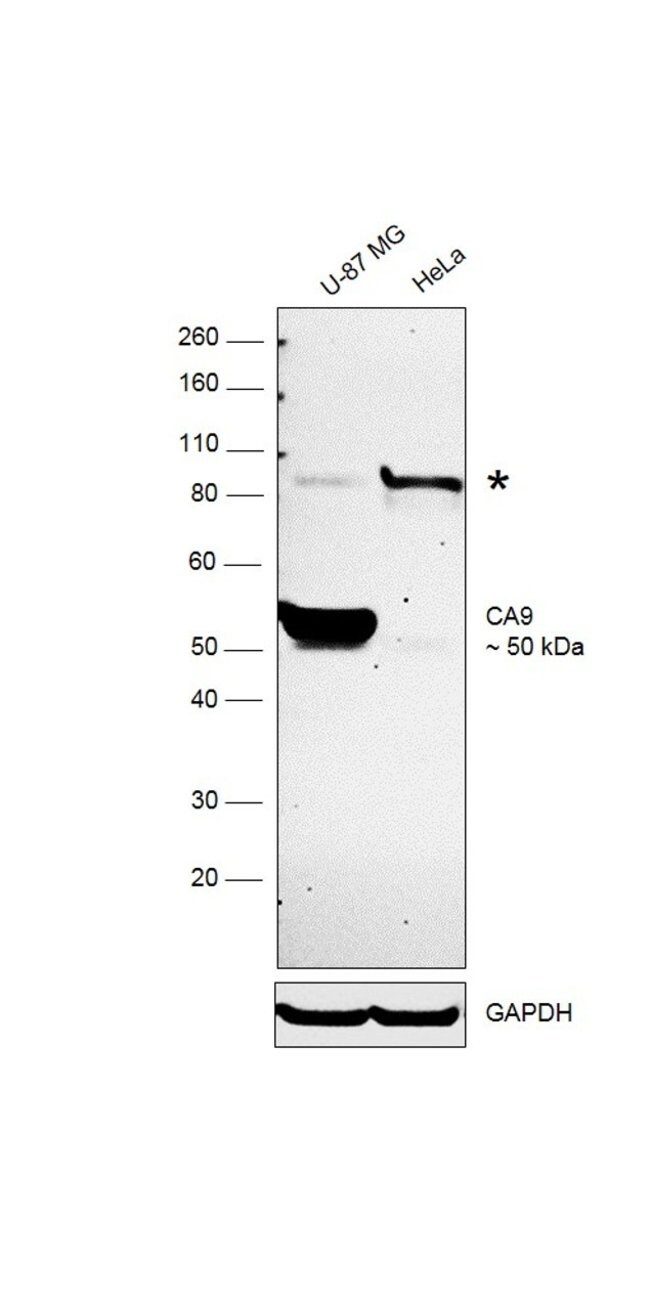
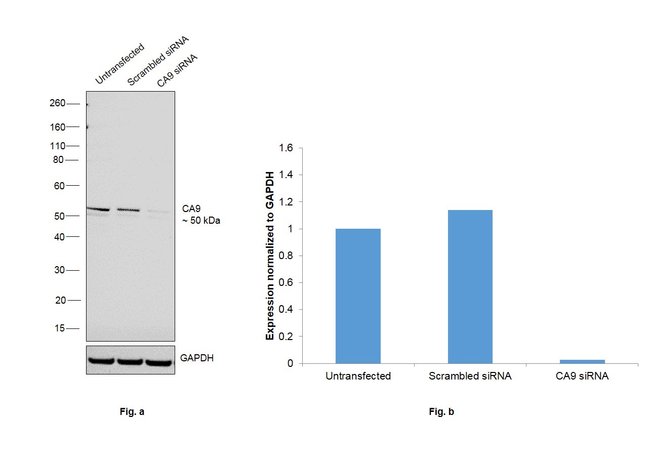
Invitrogen™ Carbonic Anhydrase IX Monoclonal Antibody (SP106)

Beschreibung
Heat-mediated antigen retrieval is recommended prior to staining, using a 10mM citrate buffer, pH 6.0, for 10 minutes followed by cooling at room temperature for 20 min. Following antigen retrieval, incubate samples with primary antibody for 10 min at room temperature. A suggested positive control is stomach tissue.
Carbonic anhydrase (CA) is an enzyme that assists rapid interconversion of carbon dioxide and water into carbonic acid, protons, and bicarbonate ions. It is abundant in all mammalian tissues. There are many genes that are inducible by hypoxia, via HIF-1 alpha. CA IX is one of the most inducible genes because of its stability and location within the membrane. Carbonic anhydrases have a widespread role in regulating pH in normal tissues, by regulating hydrogen ion (H+) flux. The pH is important in cell death under hypoxia, thus a blockade of CA IX results in increased cell death under hypoxia. Therefore, CA IX has become a reliable histochemical marker of hypoxia.

Spezifikation
Spezifikation
| Antigen | Carbonic Anhydrase IX |
| Anwendungen | Flow Cytometry, Immunohistochemistry (Paraffin), Western Blot |
| Klassifikation | Monoclonal |
| Klon | SP106 |
| Konzentration | 0.11 mg/mL |
| Konjugat | Unconjugated |
| Zusammensetzung | PBS with 1% BSA and 0.1% sodium azide; pH 7.2 |
| Gen | CA9 |
| Gen-Zugriffsnummer | Q16790 |
| Gen-Alias | Ca9; CA-9; CAIX; CA-IX; Car9; Carbonate dehydratase IX; carbonic anhydrase 9; Carbonic anhydrase IX; carbonic dehydratase; G250; Membrane antigen MN; membrane antigen MN homolog; MN; MN/CA9; P54 / 58N; P54/58N; pMW1; RCC-associated antigen G250; RCC-associated protein G250; renal cell carcinoma-associated antigen G250 |
| Mehr anzeigen |
Name des Produkts
Indem Sie auf Absenden klicken, erklären Sie sich damit einverstanden, dass Fisher Scientific sich mit Ihnen in Verbindung setzen kann, um Ihr Feedback in diesem Formular zu bearbeiten. Wir werden Ihre Informationen nicht für andere Zwecke weitergeben. Alle bereitgestellten Kontaktinformationen werden in Übereinstimmung mit unserer Datenschutzrichtlinie aufbewahrt. Datenschutzrichtlinie.
Haben Sie Verbesserungsvorschläge?