missing translation for 'onlineSavingsMsg'
Learn More
Learn More
Invitrogen™ CD150 Monoclonal Antibody (9D1), PE-Cyanine7, eBioscience™, Invitrogen™
Rat Monoclonal Antibody
150.00 € - 383.00 €
Spezifikation
| Antigen | CD150 |
|---|---|
| Klon | 9D1 |
| Konzentration | 0.2 mg/mL |
| Anwendungen | Flow Cytometry |
| Klassifikation | Monoclonal |
| Produktcode | Marke | Menge | Preis | Menge & Verfügbarkeit | |||||
|---|---|---|---|---|---|---|---|---|---|
| Produktcode | Marke | Menge | Preis | Menge & Verfügbarkeit | |||||
|
16506980
|
Invitrogen™
25-1501-80 |
25 μg |
150.00 €
25 Mikrogramm |
Log in om dit product te kopen Registreer vandaag om een webaccount aan te maken | |||||
|
16516980
|
Invitrogen™
25-1501-82 |
100 μg |
383.00 €
100 Mikrogramm |
Log in om dit product te kopen Registreer vandaag om een webaccount aan te maken | |||||
Beschreibung
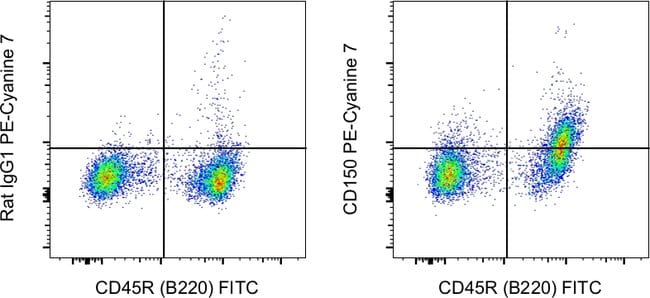
Description: The 9D1 monoclonal antibody reacts with mouse CD150, an ∽70 kDa transmembrane glycoprotein also known as Signaling Lymphocyte Activation Molecule (SLAM). CD150 is expressed by T (especially TH1) and B cells and its expression is rapidly upregulated on these cells upon activation. Immature thymocytes and dendritic cells also express this antigen. Signaling through SLAM in T cells induces proliferation and augmentation of the interferon-gamma response. Furthermore, SLAM is thought to play a role in adhesion between the T cell and antigen-presenting cell. 9D1 is reported to be an activating antibody. Mouse hematopoietic stem cells (HSC) can be identified using SLAM family markers, such as CD150+CD244-CD48-. For this application we recommend the use of antibody clone mShad150 (cat. 12-1502). Applications Reported: This 9D1 antibody has been reported for use in flow cytometric analysis. Applications Tested: This 9D1 antibody has been tested by flow cytometric analysis of mouse splenocytes. This may be used at less than or equal to 1.0 μg per test. A test is defined as the amount (μg) of antibody that will stain a cell sample in a final volume of 100 μL. Cell number should be determined empirically but can range from 10^5 to 10^8 cells/test. It is recommended that the antibody be carefully titrated for optimal performance in the assay of interest. Light sensitivity: This tandem dye is sensitive to photo-induced oxidation.
CD150 (SLAM, Signaling Lymphocyte Activation Molecule) belongs to the immunoglobulin gene superfamily, and is involved in T cell stimulation. SLAM is constitutively expressed on peripheral blood memory T cells, T cell clones, immature thymocytes, and a proportion of B cells, and is rapidly induced on naive T cells after activation. Activated B cells express the membrane bound form, the soluble form and the cytoplasmic isoforms of SLAM. It is suggested that signalling through homophilic SLAM-SLAM binding during B to B and B to T cell interactions enhances the expansion and differentiation of activated B cells. Reports suggest that the extracellular domain of CD150 is the receptor for the measles virus and acts as a co-activator on T cells and B cells. Moreover, CD150 is thought to interact with SH2D1A and with PTPN11 via its cytoplasmic domain. Mutations CD150 gene may be associated with X-linked lympho-proliferative disease (XLP).Spezifikation
| CD150 | |
| 0.2 mg/mL | |
| Monoclonal | |
| Liquid | |
| RUO | |
| PBS with 0.09% sodium azide; pH 7.2 | |
| 4933415F16; AA177906; CD150; CD150 antigen; CDw150; ESTM51; IPO-3; RGD1560634; signaling lymphocyte activation molecule; signaling lymphocytic activation molecule; signaling lymphocytic activation molecule family member 1; Slam; SLAM family member 1; Slamf1 | |
| Slamf1 | |
| Primary | |
| 4°C, store in dark, DO NOT FREEZE! | |
| Slamf1 |
| 9D1 | |
| Flow Cytometry | |
| PE-Cyanine7 | |
| Rat | |
| Mouse | |
| Q9QUM4 | |
| 27218 | |
| IgG1 κ | |
| Affinity chromatography | |
| Antibody |
Haben Sie Verbesserungsvorschläge?Übermitteln Sie eine inhaltliche Korrektur
Berichtigung von Produktinhalten
Bitte geben Sie uns Ihr Feedback zu den Produktinhalten, indem Sie das folgende Formular ausfüllen.
Name des Produkts