Learn More
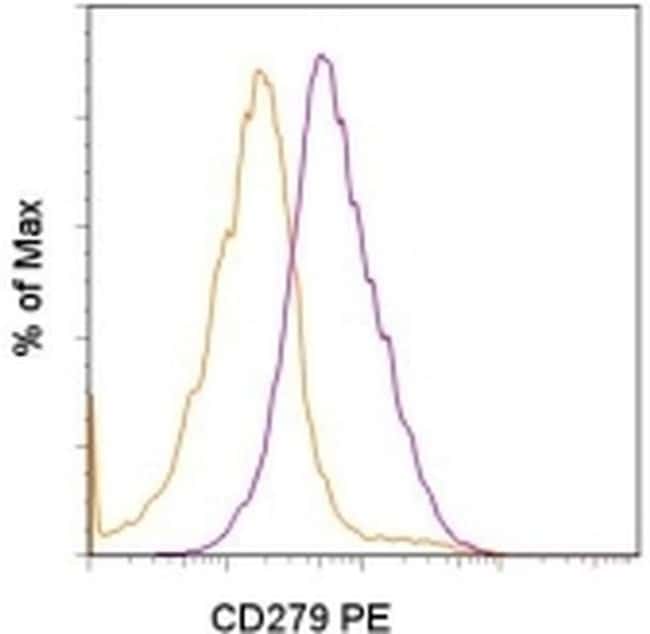
Invitrogen™ CD279 (PD-1) Monoclonal Antibody (RMP1-30), PE, eBioscience™, Invitrogen™
Beschreibung
Description: The RMP1-30 antibody reacts with mouse PD-1 (programmed death-1), a 55 kDa member of the Ig superfamily. PD-1 contains the immunoreceptor tyrosine-based inhibitory motif (ITIM) and plays a key role in peripheral tolerance and autoimmune disease in mice. PD-1 is expressed mainly on activated T and B lymphocytes. Two novel B7 Family members have been identified as PD-1 ligands, PD-L1 (B7-H1) and PD-L2 (B7-DC). Evidence reported to date suggests overlapping functions for these ligands and their constitutive expression on some normal tissues and upregulation on activated antigen-presenting cells. RMP1-30 does not block the binding of either B7-H1-Ig or B7-DC-Ig to PD-1 transfectants. Applications Reported: The RMP1-30 antibody has been reported for use in flow cytometric analysis. Applications Tested: This RMP1-30 antibody has been tested by flow cytometric analysis of Con A-stimulated mouse splenocytes. This can be used at less than or equal to 1 μg per test. A test is defined as the amount (μg) of antibody that will stain a cell sample in a final volume of 100 μL. Cell number should be determined empirically but can range from 10^5 to 10^8 cells/test. It is recommended that the antibody be carefully titrated for optimal performance in the assay of interest. Excitation: 488-561 nm; Emission: 578 nm; Laser: Blue Laser, Green Laser, Yellow-Green Laser. Filtration: 0.2 μm post-manufacturing filtered.

Spezifikation
Spezifikation
| Antigen | CD279 (PD-1) |
| Anwendungen | Flow Cytometry |
| Klassifikation | Monoclonal |
| Klon | RMP1-30 |
| Konzentration | 0.2 mg/mL |
| Konjugat | PE |
| Zusammensetzung | PBS with 0.09% sodium azide; pH 7.2 |
| Gen | Pdcd1 |
| Gen-Zugriffsnummer | Q02242 |
| Gen-Alias | CD279; EGK_05005; hPD1; hPD-1; hPD-l; hSLE1; Ly101; mPD-1; PD1; PD-1; Pdc1; Pdcd1; programmed cell death 1; programmed cell death 1 protein; programmed cell death protein 1; programmed cell death protein 1-like; programmed death 1; Protein PD1; protein PD-1; sCD279; SLEB2; soluble CD279; systemic lupus erythematosus susceptibility 2 |
| Mehr anzeigen |
For Research Use Only.
Indem Sie auf Absenden klicken, erklären Sie sich damit einverstanden, dass Fisher Scientific sich mit Ihnen in Verbindung setzen kann, um Ihr Feedback in diesem Formular zu bearbeiten. Wir werden Ihre Informationen nicht für andere Zwecke weitergeben. Alle bereitgestellten Kontaktinformationen werden in Übereinstimmung mit unserer Datenschutzrichtlinie aufbewahrt. Datenschutzrichtlinie.