Learn More

Invitrogen™ CD4 Monoclonal Antibody (N1UG0), eBioscience™, Invitrogen™
Beschreibung
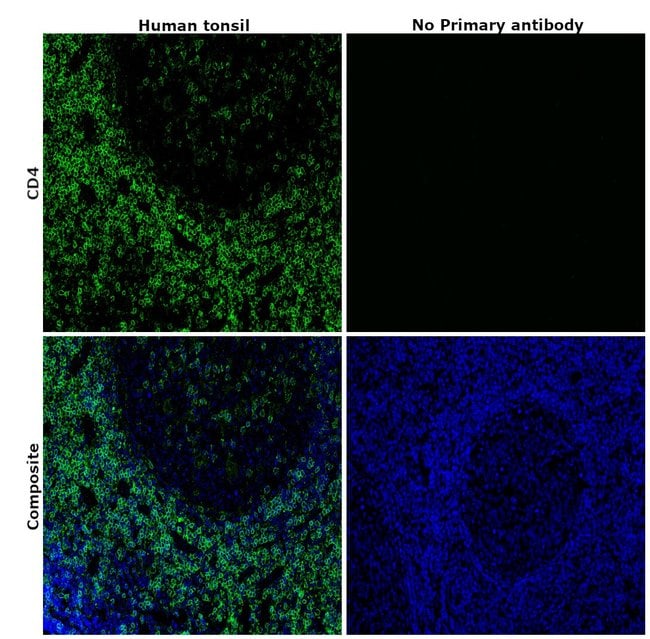
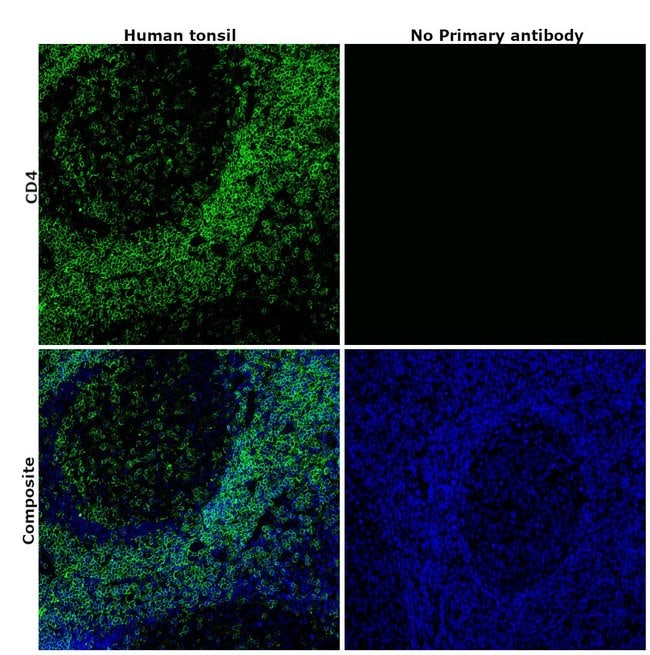
Description: The N1UG0 monoclonal antibody reacts with human CD4, a 59 kDa cell surface glycoprotein expressed by the majority of thymocytes, a subpopulation of mature T cells (T-helper cells) and in low levels on monocytes. CD4 is a receptor for the human immunodeficiency virus (HIV). The N1UG0 antibody is recommended for use in staining human formalin-fixed paraffin embedded tissue sections. Applications Reported: This N1UG0 antibody has been reported for use in western blotting and immunohistochemical staining of formalin-fixed paraffin embedded tissue sections. Applications Tested: This N1UG0 antibody has been tested by immunohistochemistry of formalin-fixed paraffin embedded human tissue using low or high pH antigen retrieval at less than or equal to 2.5 μg/mL. This N1UG0 antibody has been tested by western blot on reduced PBMC and can be used at less than or equal to 5.0 μg/mL. It is recommended that the antibody be carefully titrated for optimal performance in the assay of interest. Purity: Greater than 90%, as determined by SDS-PAGE. Aggregation: Less than 10%, as determined by HPLC. Filtration: 0.2 μm post-manufacturing filtered.

Spezifikation
Spezifikation
| Antigen | CD4 |
| Anwendungen | Immunohistochemistry (Paraffin), Western Blot |
| Klassifikation | Monoclonal |
| Klon | N1UG0 |
| Konzentration | 0.5 mg/mL |
| Konjugat | Unconjugated |
| Zusammensetzung | PBS with 0.09% sodium azide; pH 7.2 |
| Gen | CD4 |
| Gen-Zugriffsnummer | P01730 |
| Gen-Alias | Activation B7-1 antigen; B7; B7.1; B7-1; BB1; B-lymphocyte activation antigen B7; CD28LG; CD28LG1; CD4; CD4 antigen; CD4 antigen (p55); CD4 antigen p55; Cd4 molecule; CD4 precursor; CD4 receptor; CD4, allele 1; cd4a; CD4mut; CD80; CD80 antigen (CD28 antigen ligand 1, B7-1 antigen); CD80 molecule; cell surface glycoprotein CD4; costimulatory factor CD80; costimulatory molecule variant IgV-CD80; CTLA-4 counter-receptor B7.1; fCD4; L3T4; LAB7; Leu-3; Ly-4; lymphocyte antigen CD4; lymphocyte antigen CD4 precursor; membrane protein; p55; T-cell differentiation antigen L3T4; T-cell surface antigen T4/Leu-3; T-cell surface glycoprotein CD4; T-cell surface glycoprotein CD4 precursor (T-cell surface antigen T4/Leu-3) (T-cell differentiation antigen L3T4); T-lymphocyte activation antigen CD80; W3/25; W3/25 antigen |
| Mehr anzeigen |
For Research Use Only.
Indem Sie auf Absenden klicken, erklären Sie sich damit einverstanden, dass Fisher Scientific sich mit Ihnen in Verbindung setzen kann, um Ihr Feedback in diesem Formular zu bearbeiten. Wir werden Ihre Informationen nicht für andere Zwecke weitergeben. Alle bereitgestellten Kontaktinformationen werden in Übereinstimmung mit unserer Datenschutzrichtlinie aufbewahrt. Datenschutzrichtlinie.