missing translation for 'onlineSavingsMsg'
Learn More
Learn More

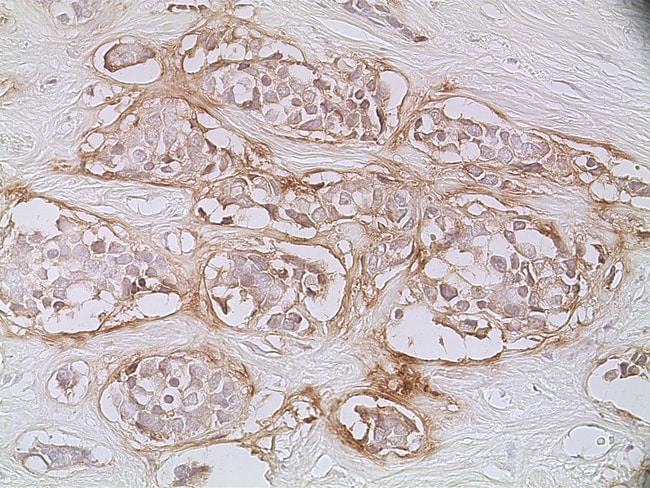
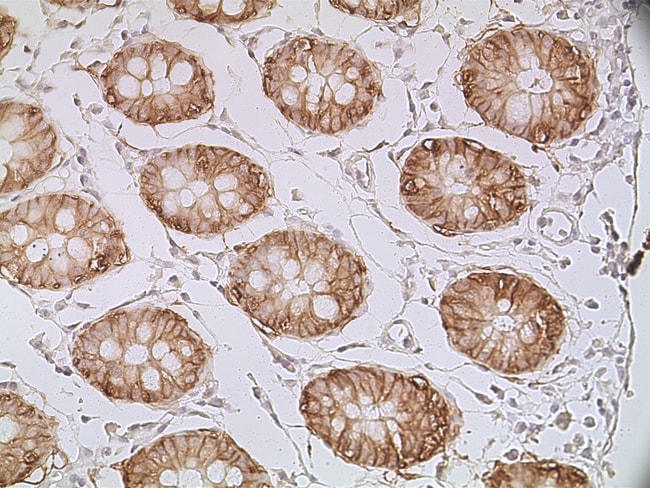
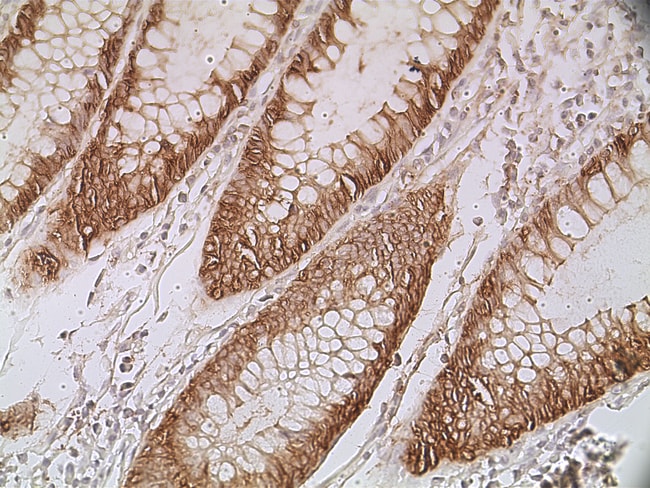
Invitrogen™ EpCAM Monoclonal Antibody (VU-1D9)

Mouse Monoclonal Antibody
Marke: Invitrogen™ MA516973
Dieser Artikel kann nicht zurückgegeben werden.
Rückgaberichtlinie anzeigen
Beschreibung
This product requires protein digestion pre-treatment of paraffin sections using trypsin or pronase. A suggested positive control for immunohistochemical applications is large bowel. For FACS analysis, use 10 μL of the suggested working dilution to label 1x10^6 cells in 100 μL. This product is a low-endotoxin, preservative-free formulation. Mouse anti Human CD326 antibody, clone VU-1D9 recognizes epithelial cell adhesion molecule (Ep-CAM), a approximately 34 kDa cell surface antigen otherwise known as CD326, MOC31 or Ber-EP4.
Ep-CAM (epithelial adhesion molecule, epithelial specific antigen, ESA) is a transmembrane glycoprotein expressed in the epithelium with a molecular weight of approximately 40 kDa, which functions as an epithelial cell adhesion molecule. Ep-CAM functions as a homotypic calcium-independent cell adhesion molecule, and has a direct impact on cell cycle, proliferation and metabolism of epithelial cells and fibroblasts due to its ability to rapidly induce the proto-oncogene c-myc and the cell cycle regulating genes cyclin A and E. Ep-CAM mediates Ca2+-independent homotypic interactions. Formation of Ep-CAM-mediated adhesions have a negative regulatory effect on adhesions mediated by classic cadherins, which may have strong effects on the differentiation and growth of epithelial cells. Ep-CAM overexpression was suggested to be associated with enhanced epithelial proliferation. Ep-CAM is highly expressed in human carcinomas, and is a marker for tumors of epithelial lineage. Ep-CAM is expressed on baso-lateral cell surface in most simple epithelia and many carcinoma types. Also, Ep-CAM reportedly distinguishes adenocarcinomas from pleural mesotheliomas.
Spezifikation
| EpCAM | |
| Monoclonal | |
| 1 mg/mL | |
| PBS with no preservative | |
| P16422 | |
| EPCAM | |
| HG9 cell line (small cell lung carcinoma). | |
| 500 μg | |
| Primary | |
| Human | |
| Antibody | |
| IgG1 |
| Flow Cytometry, Immunohistochemistry (Frozen), Immunohistochemistry (Paraffin), Immunoprecipitation, Western Blot, Immunocytochemistry | |
| VU-1D9 | |
| Unconjugated | |
| EPCAM | |
| adenocarcinoma-associated antigen; CD326; cell surface glycoprotein Trop-1; DIAR5; EGP; EGP-2; EGP314; EGP40; EPCAM; Ep-CAM; EpCAM1; epithelial cell adhesion molecule; Epithelial cell surface antigen; Epithelial glycoprotein; Epithelial glycoprotein 314; ESA; GA733-2; gp40; hEGP314; HNPCC8; human epithelial glycoprotein-2; KS 1/4 antigen; KS1/4; KSA; Ly74; lymphocyte antigen 74; M1S2; M4S1; major gastrointestinal tumor-associated protein GA733-2; mEGP314; membrane component, chromosome 4, surface marker (35kD glycoprotein); MIC18; MK-1; panepithelial glycoprotein 314; protein 289A; Protein D5.7A; Tacsd1; Tacstd1; TROP1; Trop-1 protein; Tumor-associated calcium signal transducer 1 | |
| Mouse | |
| Protein A | |
| RUO | |
| 4072 | |
| -20°C, Avoid Freeze/Thaw Cycles | |
| Liquid |
Berichtigung von Produktinhalten
Bitte geben Sie uns Ihr Feedback zu den Produktinhalten, indem Sie das folgende Formular ausfüllen.
Name des Produkts
Haben Sie Verbesserungsvorschläge?Übermitteln Sie eine inhaltliche Korrektur