missing translation for 'onlineSavingsMsg'
Learn More
Learn More
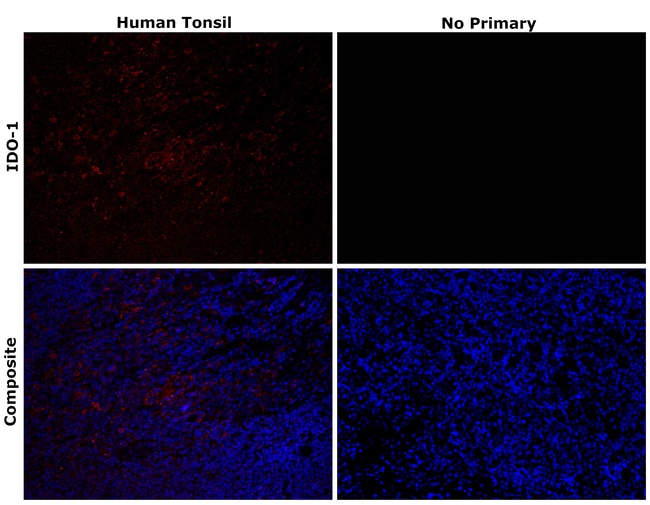
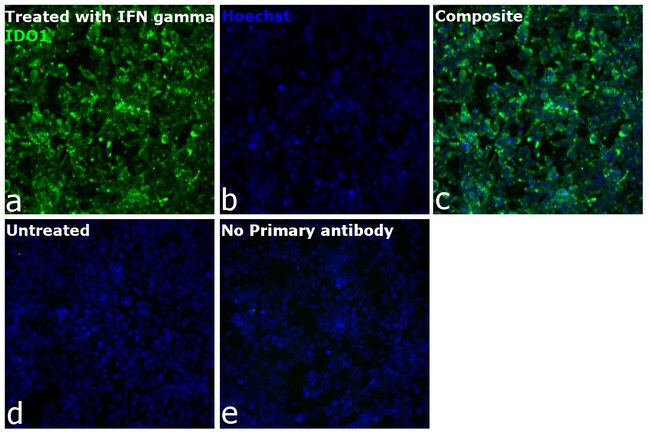
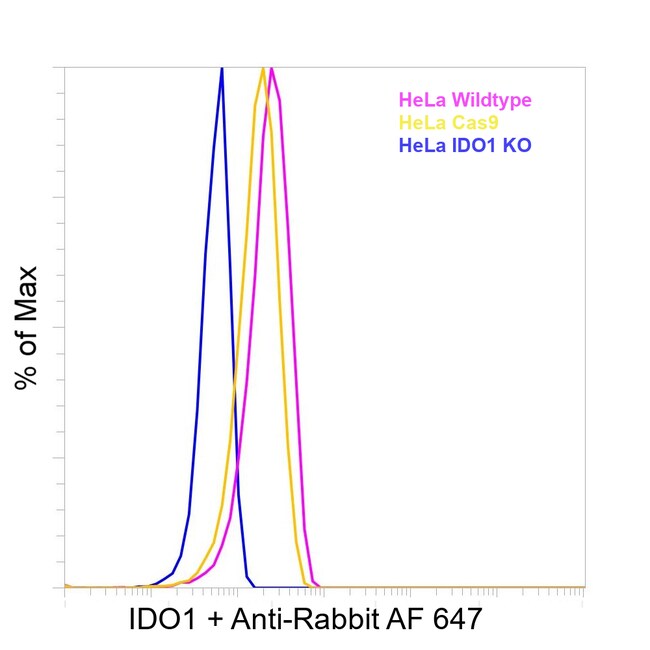
Invitrogen™ IDO Recombinant Rabbit Monoclonal Antibody (7H8L17)
Rabbit Recombinant Monoclonal Antibody
205.00 € - 359.00 €
Spezifikation
| Antigen | IDO |
|---|---|
| Klon | 7H8L17 |
| Konzentration | 0.5 mg/mL |
| Inhalt und Lagerung | Store at 4°C short term. For long term storage, store at -20°C, avoiding freeze/thaw cycles. |
| Anwendungen | Flow Cytometry, Immunohistochemistry (Paraffin), Immunocytochemistry |
| Produktcode | Marke | Menge | Preis | Menge & Verfügbarkeit | |||||
|---|---|---|---|---|---|---|---|---|---|
| Produktcode | Marke | Menge | Preis | Menge & Verfügbarkeit | |||||
|
30485012
|
Invitrogen™
740141R |
200 μL |
359.00 €
200 Mikroliter |
Log in om dit product te kopen Registreer vandaag om een webaccount aan te maken | |||||
|
30485005
|
Invitrogen™
740141RXS |
40 μL |
205.00 €
40 Mikroliter |
Log in om dit product te kopen Registreer vandaag om een webaccount aan te maken | |||||
Beschreibung
This is an engineered recombinant antibody that was developed to provide superior sensitivity without changing the paratope. Recombinant Rabbit monoclonal antibodies are produced using in vitro expression systems. Recombinant antibodies are produced using specific genes that code for the desired antibodies. These genes are cloned into an expression vector and expressed in vitro. The advantages of recombinant antibodies include better specificity and lot-to-lot consistency. It is recommended that the antibody be carefully titrated for optimal performance in the assay of interest.
IDO1 is an intracellular heme-containing enzyme that catalyzes the oxidative cleavage of the indole ring of several important regulatory molecules like tryptophan, serotonin, and melatonin. By doing this, IDO1 initiates the production of biologically active metabolites, commonly referred to as kynurenines. IDO1 is widely expressed in a variety of human tissues as well as in macrophages and dendritic cells (DCs). In inflammation, interferons (IFNs) act on specific receptors to trigger IDO1 induction. The production of IFN-gamma and induction of IDO1 represent important antimicrobial mechanisms. Degradation and depletion of tryptophan by IDO1 inhibits the growth of viruses, bacteria and parasites. Furthermore, IDO1 plays a complex and crucial role in immunoregulation during infection, pregnancy, autoimmunity, transplantation, and neoplasia.Spezifikation
| IDO | |
| 0.5 mg/mL | |
| Flow Cytometry, Immunohistochemistry (Paraffin), Immunocytochemistry | |
| Unconjugated | |
| Rabbit | |
| RUO | |
| PBS with 0.09% sodium azide; pH 7.4 | |
| P14902 | |
| 3620 | |
| Protein corresponding to human IDO (aa1-aa403). | |
| Antibody |
| 7H8L17 | |
| Store at 4°C short term. For long term storage, store at -20°C, avoiding freeze/thaw cycles. | |
| Recombinant Monoclonal | |
| Liquid | |
| IgG | |
| Human | |
| Ido1 | |
| EC 1.13.11.52; IDO; IDO1; IDO-1; INDO; indolamine 2,3 dioxygenase; indole 2,3-dioxygenase; indoleamine; indoleamine 2,3-dioxygenase 1; indoleamine 23-dioxygenase; Indoleamine-2; indoleamine-pyrrole 2,3 dioxygenase; indoleamine-pyrrole 2,3-dioxygenase | |
| Ido1 | |
| Primary | |
| Protein A |
Haben Sie Verbesserungsvorschläge?Übermitteln Sie eine inhaltliche Korrektur
Berichtigung von Produktinhalten
Bitte geben Sie uns Ihr Feedback zu den Produktinhalten, indem Sie das folgende Formular ausfüllen.
Name des Produkts