missing translation for 'onlineSavingsMsg'
Learn More
Learn More
PeproTech p16INK4a-TAT Polyclonal Antibody, PeproTech®, Invitrogen™

Rabbit Polyclonal Antibody
Marke: PeproTech 500-P284T-1MG
Dieser Artikel kann nicht zurückgegeben werden.
Rückgaberichtlinie anzeigen
Beschreibung
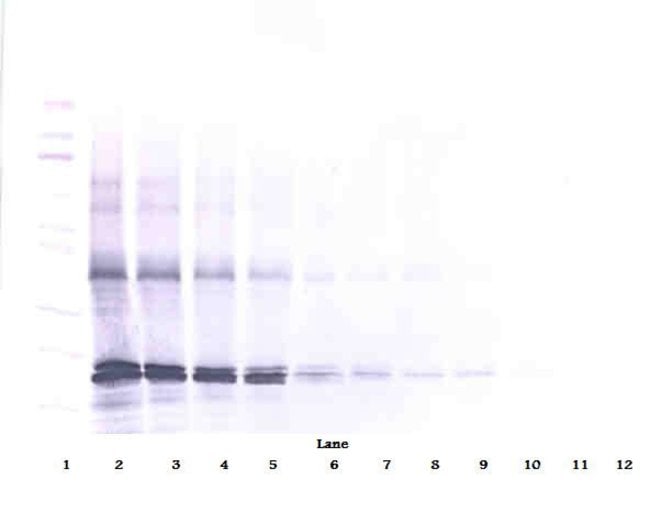
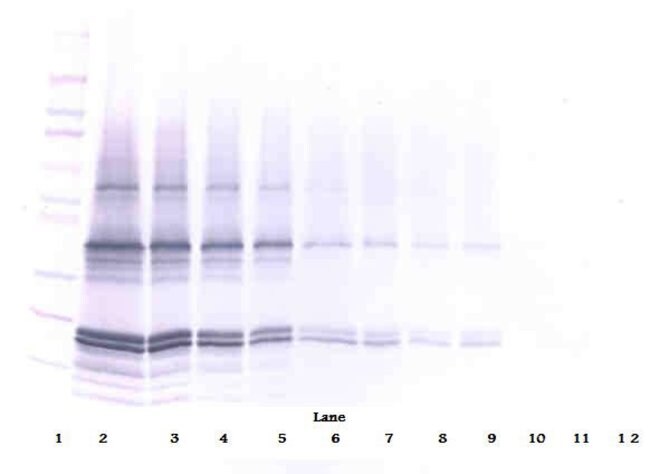
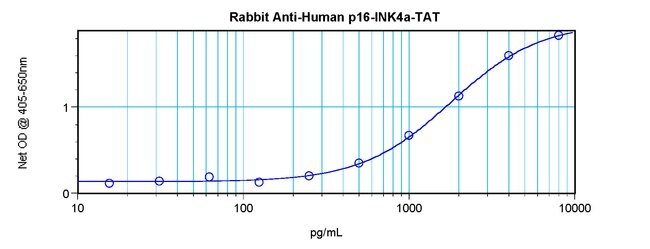
AA Sequence of recombinant protein: EPAAGSSMEP SADWLATAAA RGRVEEVRAL LEAGALPNAP NSYGRRPIQV MMMGSARVAE LLLLHGAEPN CADPATLTRP VHDAAREGFL DTLVVLHRAG ARLDVRDAWG RLPVDLAEEL GHRDVARYLR AAAGGTRGSN HARIDAAEGP SDIPDGYGR KKRRQRRR. Preparation: Produced from sera of rabbits immunized with highly pure Recombinant Human p16-INK4a-TAT. Anti-Human p16-INK4a-TAT-specific antibody was purified by affinity chromatography employing an immobilized Human p16-INK4a-TAT matrix. Sandwich ELISA: To detect Human p16-INK4a-TAT by sandwich ELISA (using100 μL/well antibody solution), a concentration of 0.5-2.0 μg/mL of this antibody is required. This antigen affinity purified antibody, in conjunction with PeproTech Biotinylated Anti-Human p16-INK4a-TAT (500-P284TBt) as a detection antibody, allows the detection of at least 0.2-0.4 ng/well of Recombinant Human p16-INK4a-TAT. Western Blot: To detect Human p16-INK4a-TAT by Western Blot analysis this antibody can be used at a concentration of 0.1-0.2 μg/mL.When used in conjunction with compatible secondary reagents, the detection limit for Recombinant Human p16-INK4a-TAT is 1.5-3.0 ng/lane, under either reducing or non-reducing conditions.
p16-INK4a is a nuclear protein that regulates the cell cycle by inhibiting cyclin-dependent kinase-4 (CDK4) and CDK6. p16-INK4a inhibits CDK activity by binding to the CDK molecules in a manner that interferes with their ability to interact with cyclin D. This activity has the effect of suppressing tumor formation and growth, and of inducing replicative senescence in various normal cells, including stem cells. The expression of p16-INK4a steadily increases with age, and tends to accumulate in stem cell compartments. The deletion, rearrangement, or mutation of the p16-INK4a gene is frequently found in melanomas, as well as in certain other types of cancer. p16-INK4a and other transcription factors have been introduced into cells by DNA transfection, viral infection, or microinjection. Protein transduction using TAT fusion proteins represents an alternative methodology for introducing transcription factors and other nuclear proteins into primary, as well as transformed, cells.
Spezifikation
| p16INK4a-TAT | |
| Polyclonal | |
| Unconjugated | |
| CDKN2A | |
| p16INK4a | |
| Rabbit | |
| Antigen affinity chromatography | |
| RUO | |
| 1029 | |
| -20°C | |
| Lyophilized |
| ELISA, Western Blot | |
| 0.1-1.0 mg/mL | |
| PBS with no preservative | |
| P42771, Q8N726 | |
| CDKN2A | |
| E.coli-derived Recombinant Human p16-INK4a-TAT. | |
| 1 mg | |
| Primary | |
| Human | |
| Antibody |
Product Content Correction
Your input is important to us. Please complete this form to provide feedback related to the content on this product.
Product Title
Spot an opportunity for improvement?Share a Content Correction