missing translation for 'onlineSavingsMsg'
Learn More
Learn More
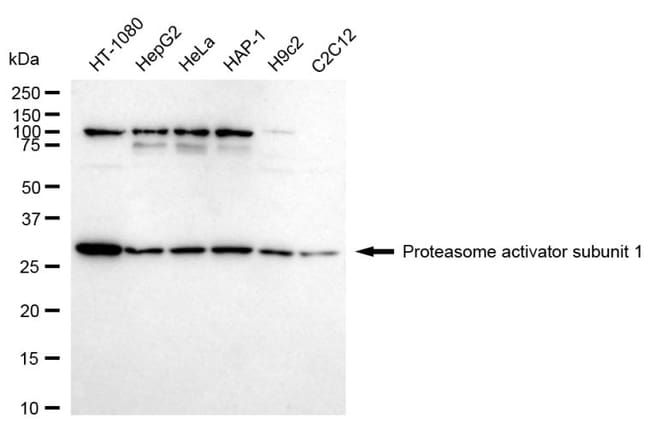
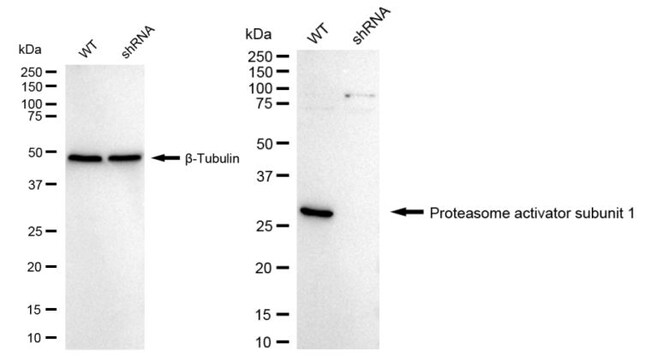
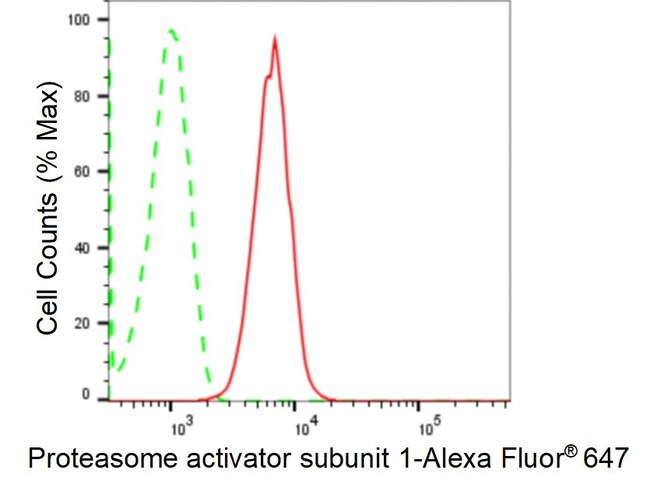
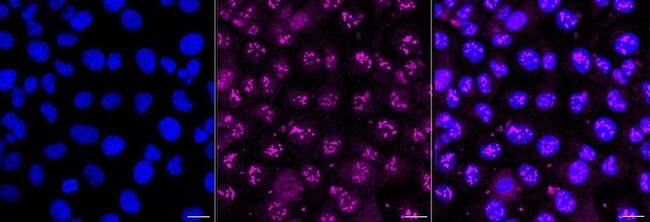
Invitrogen™ PSME1 Recombinant Rabbit Monoclonal Antibody (24GB1505)
Beschreibung
PSME1 Recombinant Monoclonal Antibody for Western Blot, Flow
Proteolytic degradation is critical to the maintenance of appropriate levels of short-lived and regulatory proteins as important and diverse as those involved in cellular metabolism, heat shock and stress response, antigen presentation, modulation of cell surface receptors and ion channels, cell cycle regulation, transcription, and signalling factors. The ubiquitin-proteasome pathway deconstructs most proteins in the eukaryotic cell cytosol and nucleus. Others are degraded via the vacuolar pathway which includes endosomes, lysosomes, and the endoplasmic reticulum. The 26S proteasome is an ATP-dependent, multisubunit (approximately 31), barrel-shaped molecular machine with an apparent molecular weight of approximately 2.5 MDa. It consists of a 20S proteolytic core complex which is crowned at one or both ends by 19S regulatory subunit complexes. The 19S regulatory subunits recognize ubiquitinated proteins and play an essential role in unfolding and translocating targets into the lumen of the 20S subunit. An enzymatic cascade is responsible for the attachment of multiple ubiquitin molecules to lysine residues of proteins targeted for degradation. Several genetic diseases are associated with defects in the ubiquitin-proteasome pathway. Some examples of affected proteins include those linked to cystic fibrosis, Angelman's syndrome, and Liddle syndrome.

Spezifikation
Spezifikation
| Antigen | PSME1 |
| Anwendungen | Flow Cytometry, Western Blot, Immunocytochemistry |
| Klassifikation | Recombinant Monoclonal |
| Klon | 24GB1505 |
| Konzentration | 0.2 mg/mL |
| Konjugat | Unconjugated |
| Zusammensetzung | PBS with 50% glycerol and 0.02% sodium azide; pH 7.4 |
| Gen | PSME1 |
| Gen-Zugriffsnummer | P97371, Q06323, Q63797 |
| Gen-Alias | 11S regulator complex subunit alpha; 29-kD MCP activator subunit; activator of multicatalytic protease subunit 1; AW413925; epididymis secretory sperm binding protein Li 129m; HEL-S-129m; I79_008549; IFI5111; IGUP I-5111; interferon gamma up-regulated I-5111 protein; interferon-gamma IEF SSP 5111; interferon-gamma-inducible protein 5111; MGC8628; OTTHUMP00000164702; PA28 alpha subunit; PA28a; PA28alpha; protease (prosome, macropain) 28 subunit, alpha; proteasome (prosome, macropain) 28 subunit, alpha; proteasome (prosome, macropain) activator subunit 1; proteasome (prosome, macropain) activator subunit 1 (PA28 alpha); proteasome activator 28 subunit alpha; Proteasome activator complex subunit 1; proteasome activator subunit 1; Psme1; REGalpha; REG-alpha |
| Mehr anzeigen |
Name des Produkts
Indem Sie auf Absenden klicken, erklären Sie sich damit einverstanden, dass Fisher Scientific sich mit Ihnen in Verbindung setzen kann, um Ihr Feedback in diesem Formular zu bearbeiten. Wir werden Ihre Informationen nicht für andere Zwecke weitergeben. Alle bereitgestellten Kontaktinformationen werden in Übereinstimmung mit unserer Datenschutzrichtlinie aufbewahrt. Datenschutzrichtlinie.
Haben Sie Verbesserungsvorschläge?